November 29th, 2007

A version of this blog post appeared on Redstate on December 1, 2007.
Those running for president are asking us them to trust them with the launch codes to the world’s most powerful and largest stockpile of nuclear weapons. Surely, then, it’s perfectly appropriate to question their judgment.
The most controversial of these judgments concerns—ironically—the candidates’ most cherished beliefs, which is to say their religious convictions.
Let’s get the caveats out of the way: The candidates are running to be our president, not our priest, so whether they say grace or how often they attend church is inconsequential.
Yet since each one has professed to be a person of deeply felt faith, they have all thereby invited us to probe what that means.
Not because, as Christopher Hitchens would have it, religion is evil—from far it—but because anything—be it religion, a book or even a wife—which a candidates claims significantly informs his thinking, warrants scrutiny.
Addendum (12/7/2007): John Dickerson points out another paradox:
[Mitt Romney] claim[s] that for voters to ask questions about his faith runs afoul of the founders’ prohibition against religious tests for office. But the legal prohibition refers to government barring people from becoming a candidate or holding office. It does not bar voters from considering religion as they make their choices.
Also, the WSJ observes that evangelical bigotry toward Mormons is grossly misplaced:
Mormons seem the very embodiment of “family values,” and you couldn’t invent a religious culture that lived more consistently with Biblical messages. Broadly speaking, most Mormons have, and come from, big families; they’re regular churchgoers and give to charity; they don’t drink, smoke, gamble or engage in premarital sex. On the scale of American problems, the Mormons don’t even register.
November 14th, 2007

Dialing in from Phoenix, where his wife Cindy is having an operation on her knee, John McCain held a conference call with bloggers this afternoon. Having learned the hard way that in order to ask a question, you need to press *1 as soon as possible, I was rewarded with the first question. With apologies to Radley Balko,
Should federal law supersede the will of the people in a given state when it comes to medical marijuana?
McCain’s answer: “There is no convincing evidence” that medical marijuana relieves pain and suffering that cannot be relieved by prescriptions.
But what about referenda in California and New Mexico, I followed-up?
The will of the people can be wrong, McCain declared. Look at Iraq today. Look at North Korea 60 years ago. “I’ll be glad to continue the discussion,” he concluded, “but I’m not changing my opinion.”
McCain’s first answer is factually inaccurate, which I hope to elaborate on tonight. His second answer is more interesting, but suffice it to say that whenever you ignore the will of the people—which you sometimes need to do—you need a very compelling reason to do so.
Quote of the day: Bloggers who criticize John McCain but haven’t come aboard his campaign bus, “remain[] attached to their couches and mattresses.”
Addendum: Phil Klein notes that Rudy and Romney also oppose decriminalizing medical marijuana.
Addendum (2/23/2008): Hendrik Hertzberg points out that
[u]nlike McCain, Obama and Clinton have at least promised to stop the feds from harassing medical marijuana patients and dispensaries in the dozen states whose laws permit marijuana to be used for medical purposes. But neither has given any indication of a willingness to rescue us from the larger disgrace of the drug war—the billions wasted, the millions harmed, the utter futility of it. On this point, hesitancy trumps hope, and expedience trumps experience.
November 11th, 2007

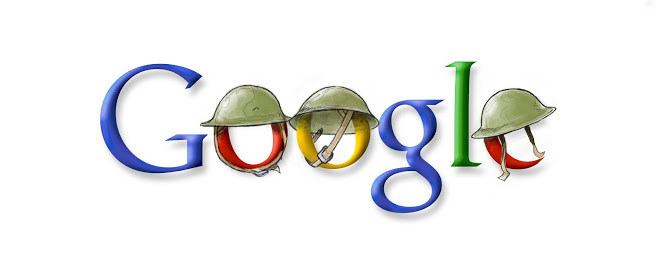
They changed it today, for Veterans’ Day. But as the LA Times reported last month, they didn’t do so last year:
The company defended its decision to let Veterans’ Day and Memorial Day pass without a special logo, saying it was trying to be respectful.
“Google’s special logos tend to be lighthearted and often scientific in nature,” spokeswoman Sunny Gettinger said in an e-mailed statement. “We do not believe we can convey the appropriate somber tone through this medium to mark holidays like Memorial Day.”
Google has altered its logo more than 140 times since 1999, according to a gallery on the company’s Web site.
The choices sometimes reflect Google’s corporate fascinations. For example, the company is so enthralled with space exploration that it recently agreed to sponsor a $30-million contest to land unmanned rovers on the moon.
That passion has been reflected in logos that commemorate some of America’s crowning achievements in space exploration, including lunar landings and Mars missions, and the birthday of noted American astronomer Percival Lowell.
Still, outrage increases in some corners of the Web for each year Google fails to honor Memorial Day.
In May, the Web site www.zombietime.com started a Memorial Day logo contest to “show Google that it’s not so hard” to make respectful ones. It has received about 250 entries, including ones that replace the second “o” with a Purple Heart medal and the “l” with the flagpole in the Iwo Jima flag-raising.
“I have no problem with Google commemorating obscure holidays or some of the trivial anniversaries that they note,” the site’s owner, who declined to give his name, said via e-mail, “just so long as they also make special logos for the more significant holidays.”
Addendum (3/25/2008): James Joyner reports, pace Kathryn Jean Lopez, that Google changed its logo for Easter.
Addendum (3/28/2008): Michael Arrington reports on Google’s change today in support of Earth Hour.
Addendum (9/22/2008): KLO continues her diatribe.
Addendum (4/28/2009): Looks like Google keeps an archive of its holiday logos.
November 11th, 2007
A version of this blog post appeared on TechRepublican on November 13, 2007.
Congratulations to Citizens Against Government Waste, which recently launched a blog, Swineline. Unfortunately, Swineline suffers from the same irritant that afflicts the blogs of the Cato Institute, Americans for Tax Reform, the Competitive Enterprise Institute, the Foundation for Defense of Democracies, and the Project on Government Oversight: It resides on a domain independent of the host organization (e.g., www.swineline.org instead of www.cagw.org/blog).
To me, this is myopic and counterproductive. Why build and drive people to an entirely new site when, by integrating the blog into your already developed site, you can centralize your traffic?
With two sites comes twice the administrative burden, whereas with one site, readers are never far from the organization’s press releases, action alerts, e-newsletters, op-eds, white papers and the all-important donate button.
Who agrees? The Sunlight Foundation, the National Taxpayers Union, the Capital Research Center, FreedomWorks, Judicial Watch, and American Solutions. (The Club for Growth doesn’t count, since its Web site is its blog, and while the Acton Institute’s blog shares the same domain as its site, the blog doesn’t maintain the same template, which cuts off easy access to the press releases, action alerts, etc.)
Related: When will AEI and IJ enter the blogosphere?
November 8th, 2007
A version of this blog post appeared on Digital Flacking on November 8, 2007.
1. Facebook does not accept PSAs. As Ryann from Facebook explained via e-mail (10/28/07), “[W]e receive an overwhelming number of requests for discounted or free advertising from charitable causes and nonprofit organizations. Due to the fact that we are unable to honor all of these requests, it is our current policy not to honor any of them.”
2. Google does not accept PSAs (it’s unclear how the one to the right got into the system). As Eileen D. from the Google AdWords Team explained via e-mail (10/31/07), “To find out more information on the public service announcements you referenced, I checked with a Google Grants specialist … She told me that this program is not currently available, and that we are currently still researching opportunities. However, as it develops, it will only be available to Google Grants accounts.”
3. Blogads does not accept PSAs. As Megan Mitzel wrote via e-mail (10/29/07), “No we do not accept public service announcements.”
4. Pajamas Media never returned my phone call or responded to my e-mail.
5. AOL accepts PSAs. As Rachel Gross, director of corporate events and community relations, wrote via e-mail (10/31/07), “We do from time-to-time offer PSAs to the community.”
November 6th, 2007

2005: “I am going to remind you that I am the No. 1 ranked conservative in the U.S. Senate. And yet I’m a big spender in two areas: national defense and infrastructure.”
2007: “I am a staunch fiscal conservative, but I am not apologetic about increased spending on our nation’s defense and infrastructure needs.”
What Inhofe willfully ignores is that national defense and fiscal discipline have always been at war with one another. By all means, we should protect the country vigorously and unapologetically, but we must remember that war, simply put, dramatically expands government, whether by curtailing civil liberties, increasing spending or stationing troops around the globe indefinitely.
Equally important, no taxpayer dollar should be exempt from “staunch fiscal conservativ[ism].” The principle of pecuniary prudence, if we take it seriously, is comprehensive and nonnegotiable.
Before entering the digital space…
I flacked for the American Conservative Union and the Cato Institute, and reported for Time magazine and the Pittsburgh Tribune-Review.